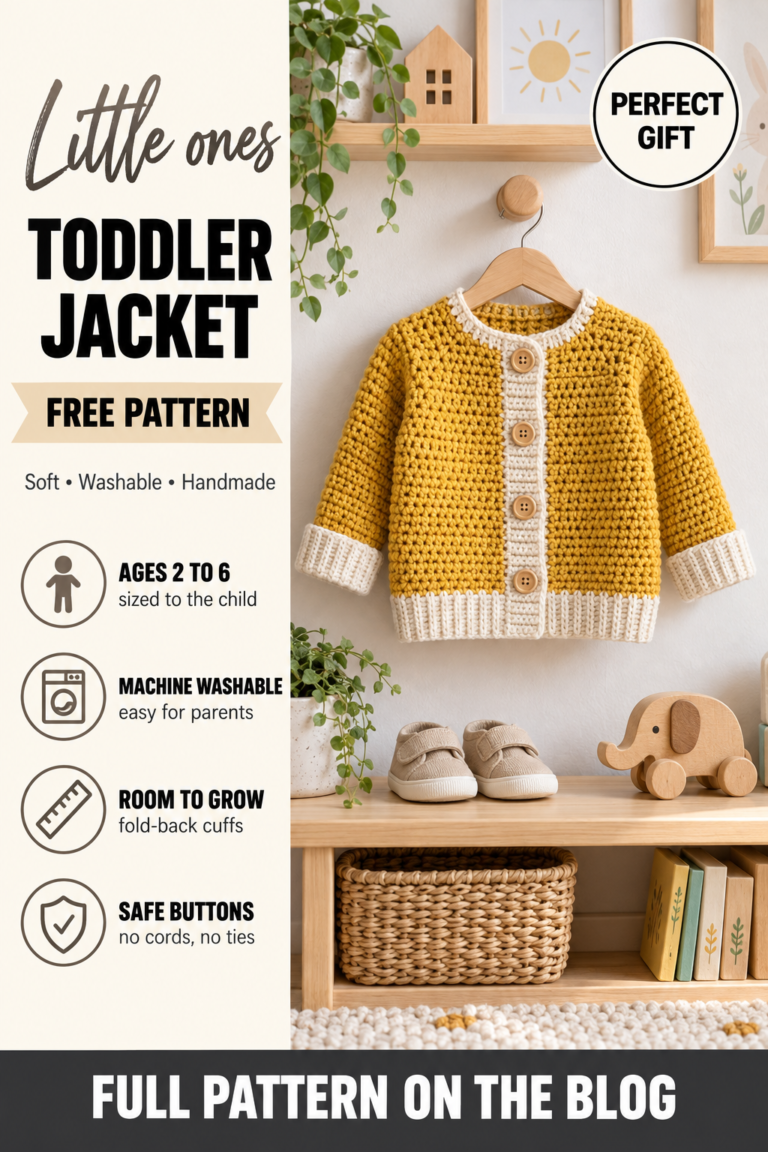
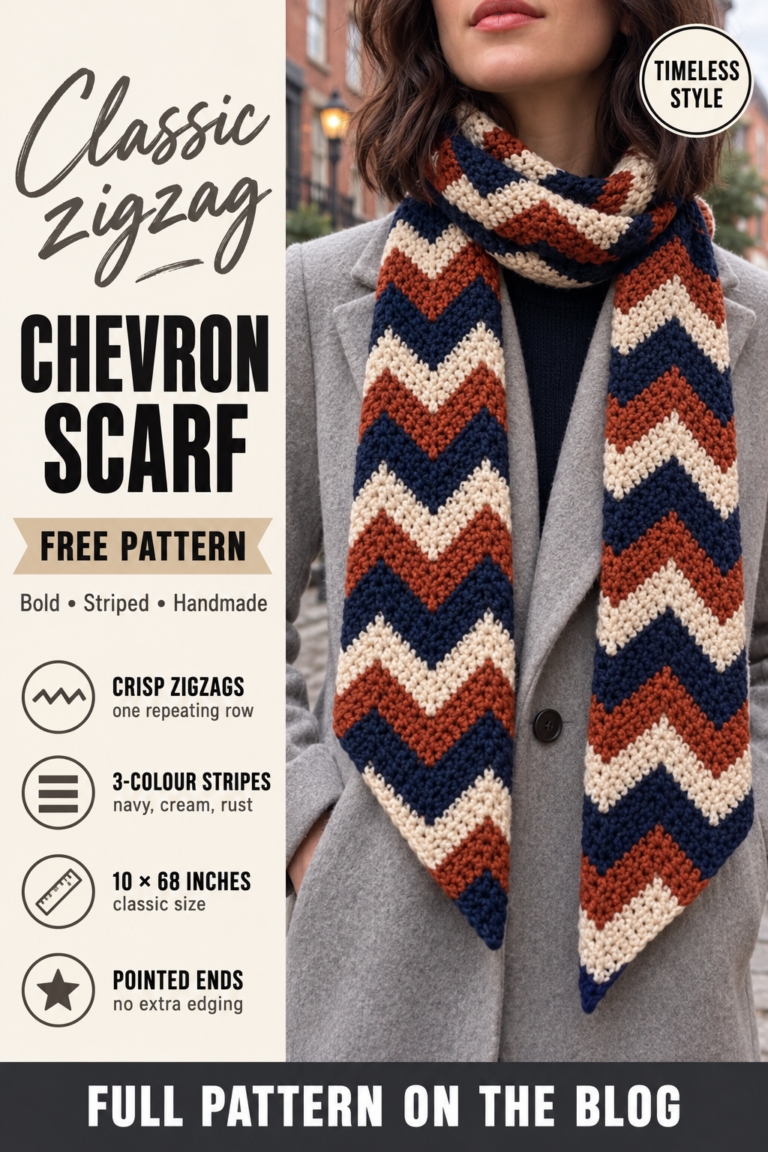
Linen Stitch Crochet Jacket in Three Blended Colours – Free Pattern
A linen stitch crochet jacket looks like it came from an expensive boutique. The fabric is so dense and even that people assume it is woven or knitted, and when you work it in three colours changed every couple of rows, the colours melt into a soft tweed that is impossible to get any other way.
The surprising part is how simple it is. Linen stitch is nothing more than single crochet and chain one, worked into the gaps of the row below. If you have made the chunky linen stitch blanket on this site, you already know the stitch; this jacket simply turns it into a garment.
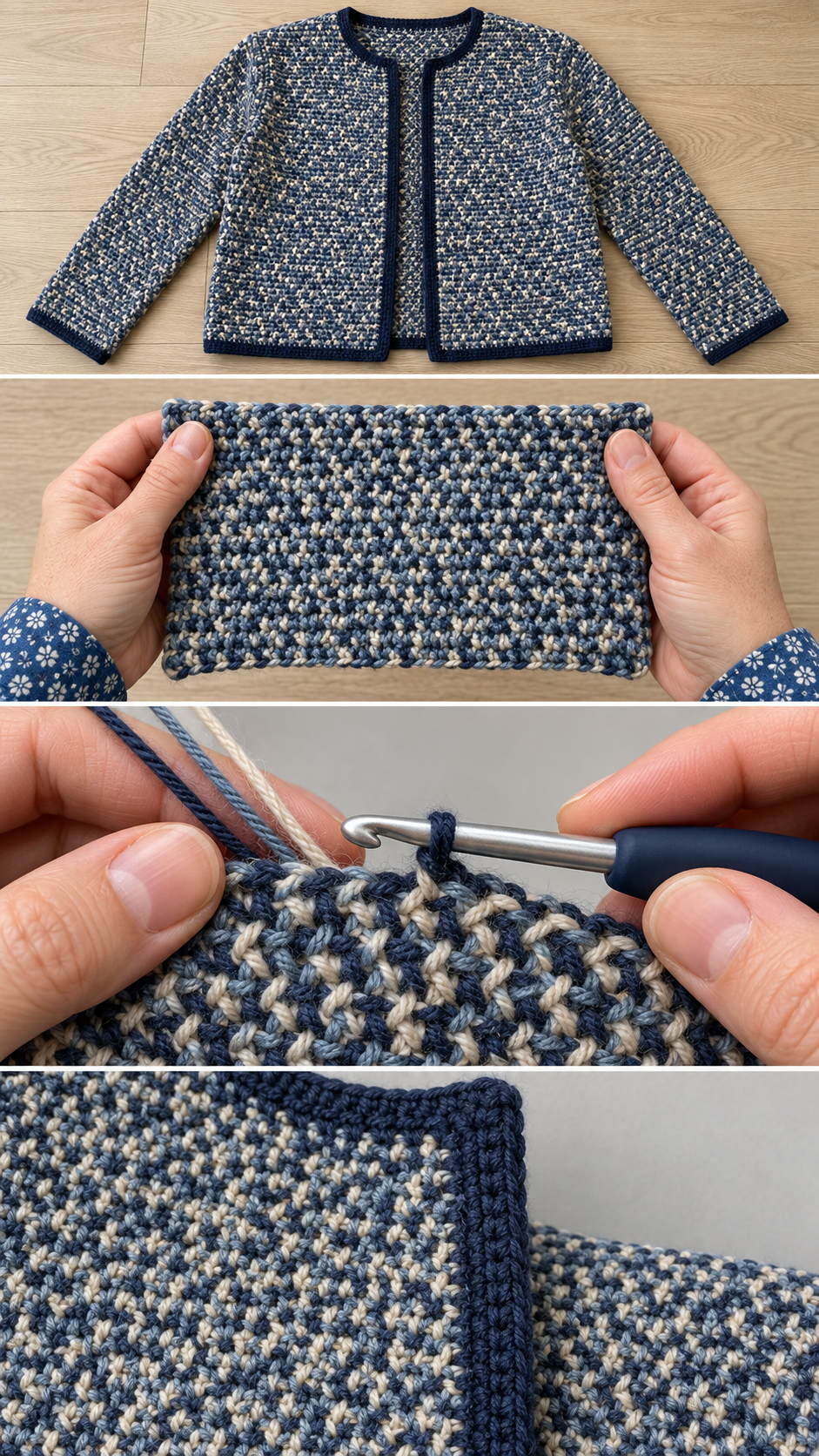
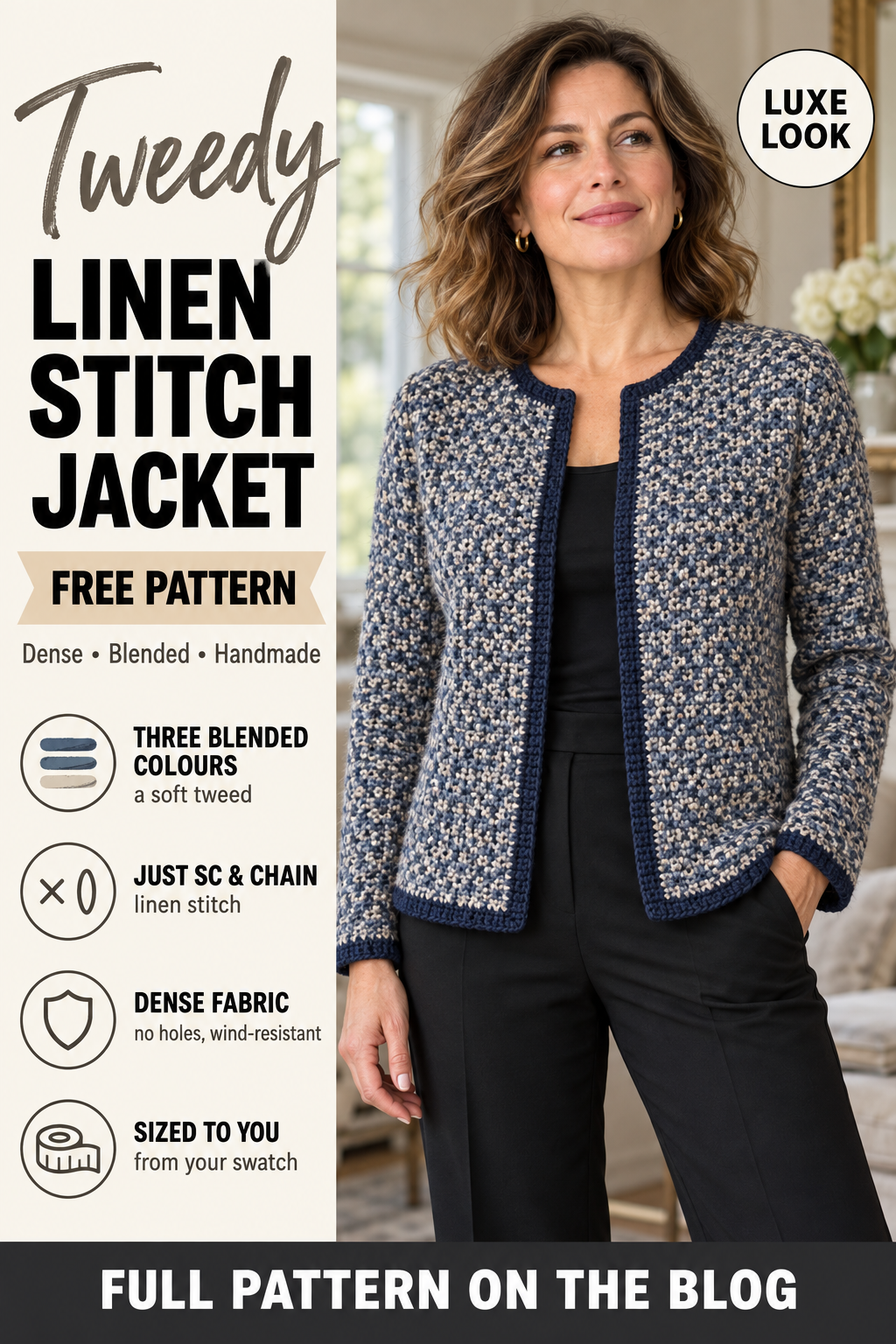
The jacket itself is boxy and collarless, with a straight front edge finished in a narrow single crochet border. It is designed to be worn open, like a classic tweed jacket, and it looks equally good over a dress or with jeans.
Why this linen stitch jacket works
Every single crochet in linen stitch goes into a chain-one space from the row below, never into a stitch. That shifts each row by half a stitch, which is what makes the fabric interlock so tightly. There are no straight lines for holes to open along, so the fabric is wind-resistant and warm for its weight.
That half-stitch shift is also why the colours blend. A stripe in most stitches sits in a hard band. In linen stitch, each row peeks between the stitches of the row below, so two-row stripes merge into a heathered, tweedy texture.
It is also self-checking: every row has exactly the same number of single crochet as the row before. Count once at the start and you can check any row afterwards.
The honest trade-off: linen stitch is slow. It produces a dense fabric, which means many stitches and many rows per inch. This jacket is a long project, best worked in a lighter yarn so it does not become heavy. It is a project for the pleasure of the process.
Materials you will need
- Yarn: DK weight (category 3) in three colours, roughly 500–700 yards of each for an adult jacket. A wool or wool-blend yarn gives the best drape.
- Hook: 5.0 mm (H-8) — deliberately larger than a DK label suggests, because linen stitch pulls in tightly
- Notions: tapestry needle, stitch markers, pins
Choose three colours that are close in tone: a dark, a medium and a light from the same family — navy, slate and cream, or rust, camel and oatmeal. Colours that are too far apart look stripy rather than tweedy.
Gauge and sizing
Chain 30 and work 20 rows of linen stitch as below, changing colour every two rows. Block it, then count both the single crochets and the chain-ones across 4″ — in linen stitch they take up about the same width, so together they are your stitches per inch.
Add 4–6″ of ease to your bust for a classic boxy fit. Then:
- Back width = finished chest ÷ 2
- Each front width = finished chest ÷ 4 (the fronts do not overlap)
- Body length = shoulder to hem
- Sleeve length = centre-back-to-wrist − (back width ÷ 2)
- Sleeve width = about 15–17″
Multiply each width by your stitches per inch and round to the nearest even number for the foundation chain. Linen stitch needs an even chain to come out right at both edges.
Abbreviations
- ch = chain.
- sc = single crochet.
- ch-1 sp = the gap under a single chain from the row below. Every sc from Row 2 onward goes here.
- sk = skip.
- sl st = slip stitch.
The linen stitch
Foundation: Ch an even number.
Row 1: Sc in the 4th ch from hook. *Ch 1, sk next ch, sc in next ch*; repeat across. Turn.
Row 2: Ch 2. Sc in the first ch-1 sp. *Ch 1, sc in next ch-1 sp*; repeat across, working the last sc into the space under the turning chain. Turn.
Repeat Row 2 for the whole piece.
Changing colours
Change colour every two rows, always in the same order: dark, medium, light, dark, medium, light. Change on the last yarn-over of the final sc of a row.
Because you change every two rows, each colour finishes at the same edge it started from. Carry the two unused colours loosely up that side edge, twisting them once with the working yarn every couple of rows, rather than cutting them. The side seams will hide the carries completely, and you save yourself hundreds of ends to weave in.
Step by step
Part 1: The back
Chain the back width in stitches, rounded to an even number. Work linen stitch with the colour sequence until the back reaches the body length. Fasten off all three colours.
Part 2: The fronts (make 2)
Work as the back, using the front width, to the same number of rows. Start the colour sequence on the same colour as the back so the stripes line up across the side seams.
Part 3: The sleeves (make 2)
Work as the back, using the sleeve width, to your sleeve length. Start the colour sequence so the last rows match the body colour at the armhole.
Part 4: Assembly
Block every piece before joining. Join the shoulders, leaving a back neck opening of about 7″. Set the sleeves into the sides, matching the centre of each sleeve top to a shoulder seam. Sew the side and underarm seams in one line, working the seam over the carried yarns so they disappear inside.
Part 5: The border
With the darkest colour, join at a side seam at the hem. Work one round of sc evenly around the whole jacket edge — hem, up the front, around the neck and down the other front — with 3 sc in each corner. Work a second round of sc. Then do the same around each cuff.
A narrow dark border frames the tweed beautifully and stops the edges from stretching.
Making it look tailored
Linen stitch blocks beautifully, and blocking is what makes this jacket look tailored. Wet the finished jacket, lay it flat on towels, and pat the front edges straight and parallel. Push the shoulders to a crisp line. As it dries, it sets into a firm, structured shape that holds for years.
For an even more polished look, sew a strip of grosgrain ribbon along the inside of each front edge. It stops the front from stretching and makes the jacket hang perfectly straight.
Finishing and care
Weave the cut ends into the seams. Hand wash cool and dry flat, reshaping the front edges while damp. Store folded.
Frequently asked
Why is my fabric stiff?
Your hook is too small. Linen stitch needs a hook one or two sizes larger than the yarn label suggests.
Why are my edges uneven?
The last sc of each row belongs in the space under the turning chain. Mark it with a stitch marker until it becomes habit.
Can I use one colour?
Yes, and the jacket looks quietly elegant. The texture still shows beautifully in a single colour.
Planning your three colours
The tweed effect depends on value — how light or dark each colour is — more than on the colours themselves. Lay the three balls side by side and take a black-and-white photo with your phone. If the dark, medium and light look clearly different in grey, the tweed will be rich and visible. If two look the same, swap one, or the jacket will look like two colours instead of three.
A good rule is to keep all three colours in the same temperature: all warm, like rust, camel and cream, or all cool, like navy, slate and pale grey. Mixing warm and cool tones tends to look muddy in linen stitch.
How long it takes
Linen stitch is slow but very relaxing. Expect an adult jacket in DK yarn to take several weeks of regular evenings. It is the kind of project to keep beside the sofa and work a few rows at a time. Because every row is the same, you never need to look at the pattern once you have started.
Common mistakes
The width is shrinking: the last stitch of a row was missed. The colours look stripy: the colours are too far apart in value, or you are changing every four rows instead of two. The carried yarn shows at the edge: twist the colours more often, and pull the carries snug but not tight.
Wearing it through the year
In DK wool, a linen stitch jacket is warm enough for a cool autumn day yet light enough to wear indoors. Over a summer dress on a breezy evening, it adds polish without bulk. In winter, wear it under a coat as a structured extra layer.
Before you start
Make the swatch in your three colours. It shows you the tweed effect, your gauge and whether the colours blend, all in one small square. More wearable makes are in Clothing & Wearables.