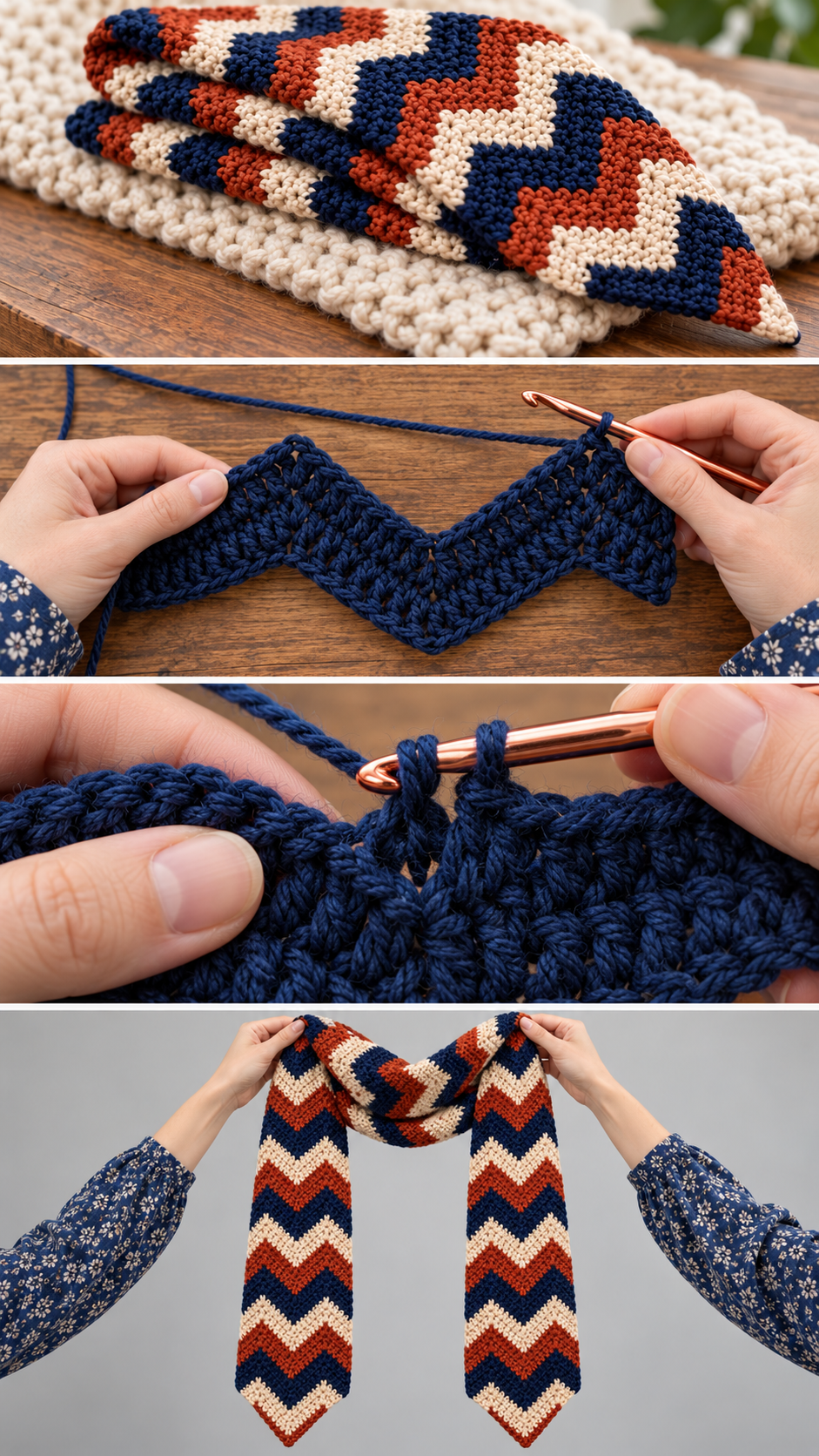
Striped Crochet Chevron Scarf – Free Zigzag Pattern
A striped chevron scarf in navy, cream and rust is a classic that never goes out of style. The zigzag stripes look bold and graphic, but the stitch behind them is simple: a few increases and decreases in every row make the peaks and valleys appear by themselves.
This crochet chevron scarf is worked flat in short rows across the width, so it is a great portable project. Every row is the same, which means once you have made the first one you know the whole pattern.
If you can make a double crochet and are ready to learn a decrease, you can make this. Chevron is one of the most satisfying stitches to learn, because you can see the pattern take shape after just a few rows.
Why this crochet scarf works
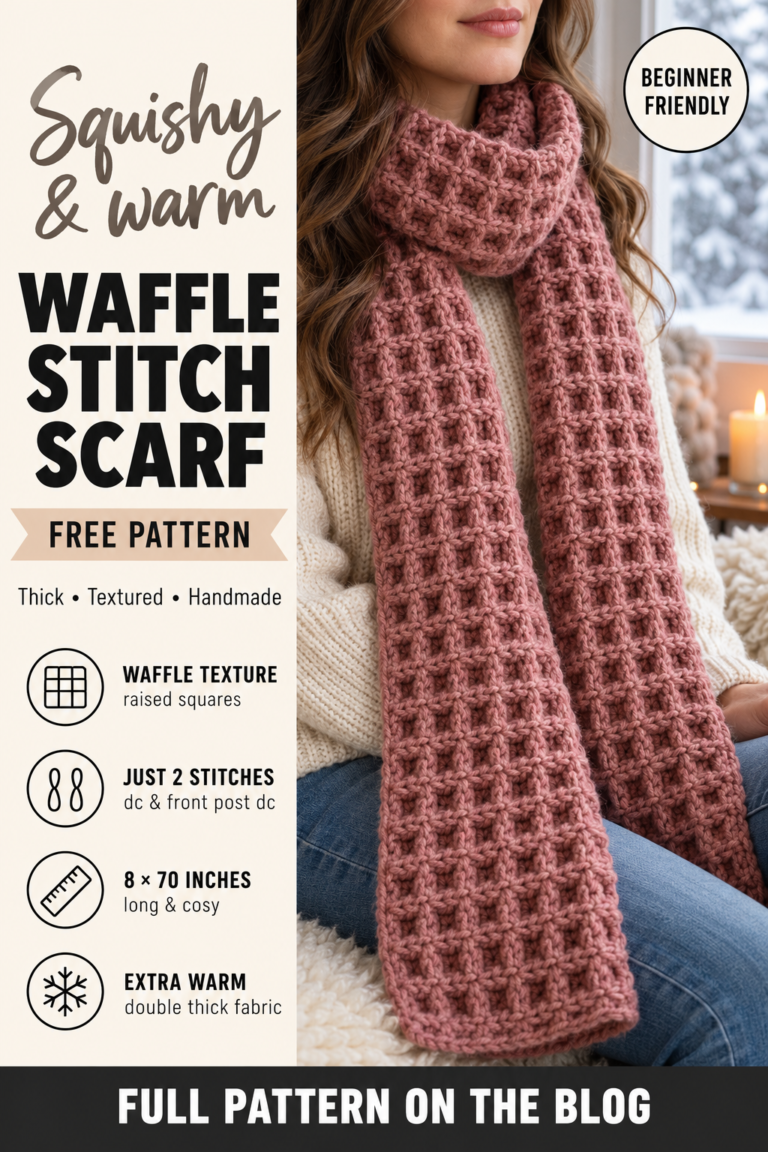
Each row has the same number of increases and decreases. Where you work two double crochets into one stitch, the fabric spreads out and forms a peak; where you work two stitches together, it pulls in and forms a valley. Because they balance, the scarf stays the same width, and each row stacks neatly on top of the last, so the zigzag stays crisp all the way up.
The peaks and valleys give the edges of the scarf a pointed, scalloped shape, which looks lovely at the ends and stops the scarf from looking like a plain rectangle.
The honest trade-off: chevron depends on accurate counting. If you lose one stitch, the zigzags slowly drift. Count each row for the first few repeats until the rhythm becomes natural.
Materials you will need
- Yarn: about 750 yards of worsted weight (#4) yarn in total — about 300 yards of navy, 250 yards of cream and 200 yards of rust
- Hook: 5 mm (H-8)
- Notions: stitch markers, tapestry needle, scissors
Gauge and finished size
In chevron pattern with a 5 mm hook, one 12-stitch repeat is about 3½″ wide and 8 rows make about 4″. The finished scarf is about 10″ wide and 68″ long.
Abbreviations
- ch = chain: yarn over and pull through the loop on your hook.
- sl st = slip stitch: insert hook, pull a loop through the stitch and the loop on your hook together.
- sc = single crochet: insert hook, yarn over and pull up a loop (2 loops on hook), yarn over and pull through both.
- hdc = half double crochet: yarn over, insert hook, pull up a loop (3 loops), yarn over and pull through all 3.
- dc = double crochet: yarn over, insert hook, pull up a loop (3 loops), yarn over and pull through 2, yarn over and pull through the last 2.
- st(s) = stitch(es); sp = space; tch = turning chain; BLO = back loop only.
- dc2tog = double crochet 2 together: (yarn over, insert hook in the next st, yarn over and pull up a loop, yarn over and pull through 2 loops) twice, yarn over and pull through all 3 loops.
Pattern notes
- The scarf is worked flat in rows, turning at the end of each row.
- The ch 3 at the beginning of each row counts as a dc.
- The stitch count is 36 on every row: three 12-stitch repeats.
- Place a marker in the middle of each peak (the 2 increases) on the first few rows to help you keep track.
Step by step
Setting up
With navy, ch 39.
Row 1: Dc in the 4th ch from the hook (the 3 skipped chains count as a dc). *Dc in the next 3 ch, dc2tog twice, dc in the next 3 ch, 2 dc in each of the next 2 ch*; repeat from * once more. Dc in the next 3 ch, dc2tog twice, dc in the next 3 ch, 2 dc in the last ch. Turn. (36)
Row 2: Ch 3 (counts as dc), dc in the first st. *Dc in the next 3 sts, dc2tog twice, dc in the next 3 sts, 2 dc in each of the next 2 sts*; repeat from * once more. Dc in the next 3 sts, dc2tog twice, dc in the next 3 sts, 2 dc in the top of the turning chain. Turn. (36)
Rows 3 onwards: Repeat Row 2, changing colour as below.
Every row starts and ends with a half peak at the edges, two full peaks in between, and three valleys. The increases always sit on top of increases, and the decreases on top of decreases.
Stripe sequence
Work 4 rows navy, 2 rows cream, 2 rows rust, 2 rows cream. Repeat this 10-row sequence 13 times (130 rows), then work 4 more rows of navy so the scarf begins and ends in navy. That is 134 rows and about 68″. Fasten off and weave in the ends.
Optional: fringe on the points
For a fun finish, knot a 10″ tassel of 4 strands of rust through each peak along both short ends.
Tips for crisp chevrons
- Count every row at first. 36 stitches, every time.
- Work in the back loop for texture. Working every row in the back loop only adds a ridge under each stripe and makes the zigzags pop.
- Block it. Pinning the peaks and valleys while the scarf dries makes the points sharp.
- Carry, do not cut. Carry the colours not in use up the side of the scarf, so there are fewer ends to weave in.
Variations
- Wider wrap: add 12 chains for each extra repeat.
- Rainbow chevron: change colour every 2 rows through the whole rainbow.
- Two colours: alternate 2 rows each of charcoal and cream for a modern graphic look.
How long should a crochet scarf be?
There is no single right length, but these measurements are a good guide. A child’s scarf is about 40–48″ long. An adult scarf that wraps once with the ends hanging down the front is about 60–65″. A long scarf that wraps twice, or can be tied in a loose knot, is about 70–80″. A good rule of thumb is to make the scarf roughly as long as the wearer is tall, minus about a foot.
Width matters just as much. A slim scarf of 6–7″ is neat under a coat collar. An everyday scarf is 8–10″. Anything 12″ or wider becomes a wrap or blanket scarf that can be worn over the shoulders. Every pattern in this collection gives the stitch multiple, so you can make it wider or narrower.
Choosing yarn for a scarf
A scarf sits right against the neck and face, so softness matters more than for almost any other project. Hold a skein against your neck in the shop before you buy it. Wool and wool blends are the warmest and the most forgiving — they bounce back after wear and block beautifully. Merino is the softest wool and rarely itches. Acrylic is affordable, machine washable and comes in every colour, which makes it a practical choice for gifts and for children. Alpaca and alpaca blends are very warm and silky but can stretch a little with wear.
Avoid stiff cottons for a winter scarf: they are not very warm and can feel heavy. And for textured stitches like waffle, cluster and moss stitch, choose a smooth, plied yarn rather than a fuzzy or bouclé one — the texture shows up far better.
Always buy all the yarn for one scarf from the same dye lot. A scarf is one long piece, and a change in shade halfway through is very easy to see.
Common problems and fixes
My peaks are drifting sideways.
You have lost or gained a stitch. Count back to the last correct row and check each repeat has exactly 12 stitches.
The edges are not straight.
Make sure you work 2 dc into the first stitch and 2 dc into the top of the turning chain at the end.
The valleys have holes.
Tighten your tension on the dc2tog, and make sure you finish both halves of each decrease.
Blocking and finishing
Blocking makes a big difference to a scarf: it evens out the stitches, straightens the edges and gives the fabric a lovely drape. For wool and wool blends, soak the scarf in cool water for twenty minutes, squeeze out the water gently (never wring), roll it in a towel, then lay it flat on blocking mats or a clean towel, pat it to the right width and length, and leave it to dry completely. For acrylic, lay the scarf flat, pin it to shape and hover a steam iron just above it — never press the iron onto acrylic, or it will go flat and shiny for good.
Caring for your scarf
Hand wash wool scarves in cool water with a wool wash, and dry them flat. Acrylic scarves can usually go in the washing machine on a gentle cycle inside a mesh bag, then dry flat. Never hang a crochet scarf to dry — the weight of the wet yarn will stretch it. To store, fold it rather than hanging it on a hook, and keep wool scarves with a cedar block over the summer to keep moths away.
More crochet scarf patterns in this collection
This is one of six free crochet scarf patterns, each in a completely different stitch and style — from a squishy textured waffle to a boho granny stripe with tassels. Pick the one that suits your skill, your yarn and the look you want, or make a few as winter gifts.
- Waffle Stitch Scarf
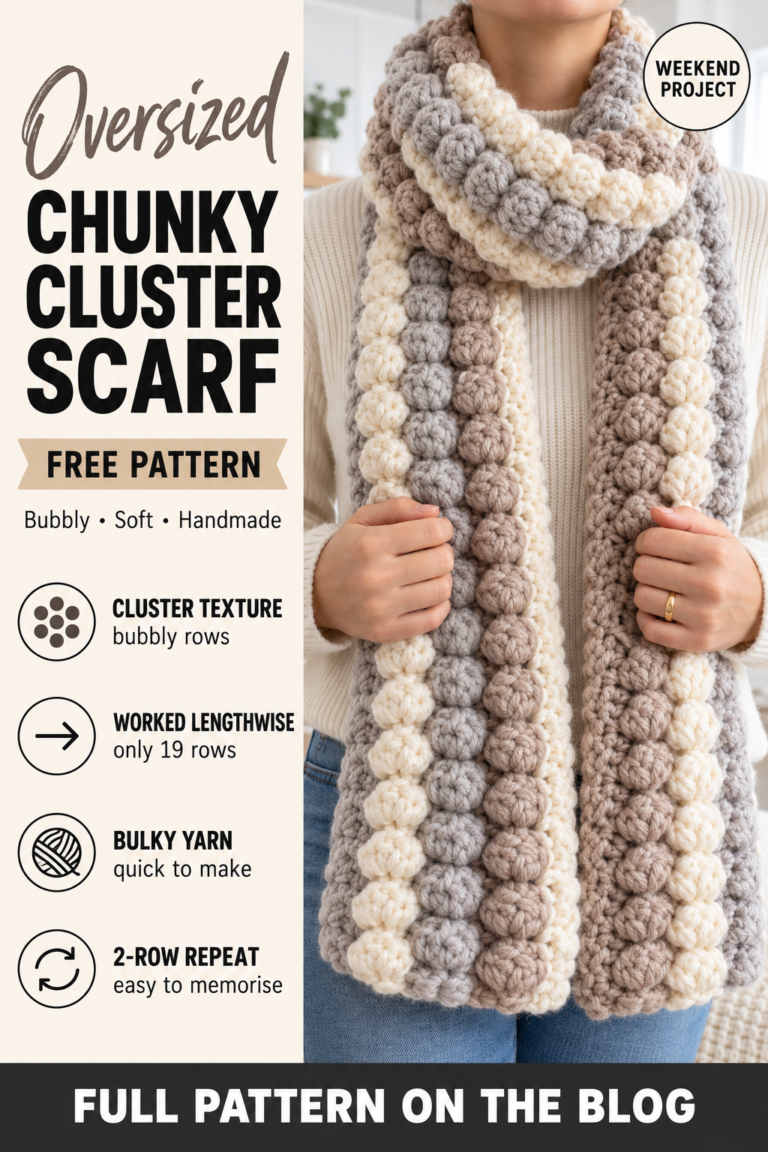
- Chunky Cluster Stitch Scarf
- Chunky Ribbed Scarf
- Granny Stripe Tassel Scarf
- Moss Stitch Infinity Scarf
- Striped Chevron Scarf — you are here
Frequently asked
Is chevron the same as ripple?
Yes. Chevron usually means sharp, pointed zigzags, and ripple means softer, rounded waves, but the method is the same.
How long does it take?
About 12 hours. It is a perfect long-term project for winter evenings.
Before you start
Make Row 1 and Row 2, then count both. If both have 36 stitches and two clear peaks, you are ready for the whole scarf. More patterns are in Hats & Scarves.