Jack-o’-Lantern Crochet Coaster – Free Halloween Pattern
A jack-o’-lantern crochet coaster is the friendliest thing on a Halloween table. It is a bright orange circle with a little green stem sticking out of the top and a face you choose yourself: happy, spooky, cheeky or surprised. Make a set with a different expression on each and everyone at the table gets their own personality under their mug.
The coaster is a flat circle of double crochet, finished with a firm edge and a small crocheted stem tab. The face is made from tiny crochet triangles for the eyes and nose, with the mouth embroidered, so you can change the expression completely without changing the pattern.
You need double crochet, single crochet and a decrease. It is a very good first Halloween project.
Why this jack-o’-lantern coaster works
A double crochet circle grows by twelve stitches a round, which keeps it flat and makes every round checkable: 12, 24, 36, 48. Four rounds give a coaster about four inches across, right for most mugs.
The face is added on top rather than crocheted into the circle. That keeps the coaster flat and smooth, and it means the face is entirely up to you. Small triangles for eyes and nose are quick to make, and an embroidered mouth can be any shape.
The honest trade-off: appliqué pieces sit slightly raised on the surface, so a glass placed exactly on a face may sit very slightly unevenly. Keep the triangles small and sew them flat, and it is not noticeable.
Materials you will need
- Orange yarn: about 20 yards of worsted weight cotton
- Black yarn: a few yards for the face
- Green yarn: a couple of yards for the stem
- Hook: 4.0 mm (G-6)
- Notions: tapestry needle, scissors, pins
Finished size
About 4¼″ across, plus the stem.
Abbreviations
- MR = magic ring: a loop you work the first round into, then pull tight to close.
- ch = chain.
- sc = single crochet: insert hook, yarn over and pull up a loop (2 loops on hook), yarn over and pull through both.
- dc = double crochet: yarn over, insert hook, yarn over and pull up a loop (3 loops), yarn over and pull through 2, yarn over and pull through the last 2.
- inc = 2 dc in the same stitch.
- sl st = slip stitch.
- rev sc = reverse single crochet, or crab stitch: sc worked from left to right, giving a corded edge.
- sc2tog = decrease: pull up a loop in each of the next two stitches (3 loops on hook), yarn over and pull through all 3.
Step by step
Part 1: The orange circle
With orange:
Round 1: Make a MR. Ch 3 (counts as first dc), work 11 dc into the ring. Pull closed and join with a sl st to the top of the ch 3. (12)
Round 2: Ch 3, dc in the same st. Inc in each remaining st around. Join. (24)
Round 3: Ch 3, dc in the same st, dc in the next st. *Inc in the next st, dc in the next st*; repeat around. Join. (36)
Round 4: Ch 3, dc in the next st, inc in the next st. *Dc in the next 2 sts, inc in the next st*; repeat around. Join. (48)
Round 5: Ch 1, sc in each st around. Join. (48)
Part 2: The stem tab
Without fastening off, change to green. Ch 4. Sc in the 2nd ch from hook and in the next 2 ch, then sl st into the next stitch of the circle. Fasten off. The little tab sticks out at the top like a pumpkin stem.
Choose the spot for the stem before you start the face — it decides which way is up.
Part 3: The eyes and nose
Make three small triangles in black.
Row 1: Ch 5. Sc in the 2nd ch from hook and in each ch across. Turn. (4)
Row 2: Ch 1, sc2tog twice. Turn. (2)
Row 3: Ch 1, sc2tog. (1) Fasten off with a long tail.
Part 4: The face
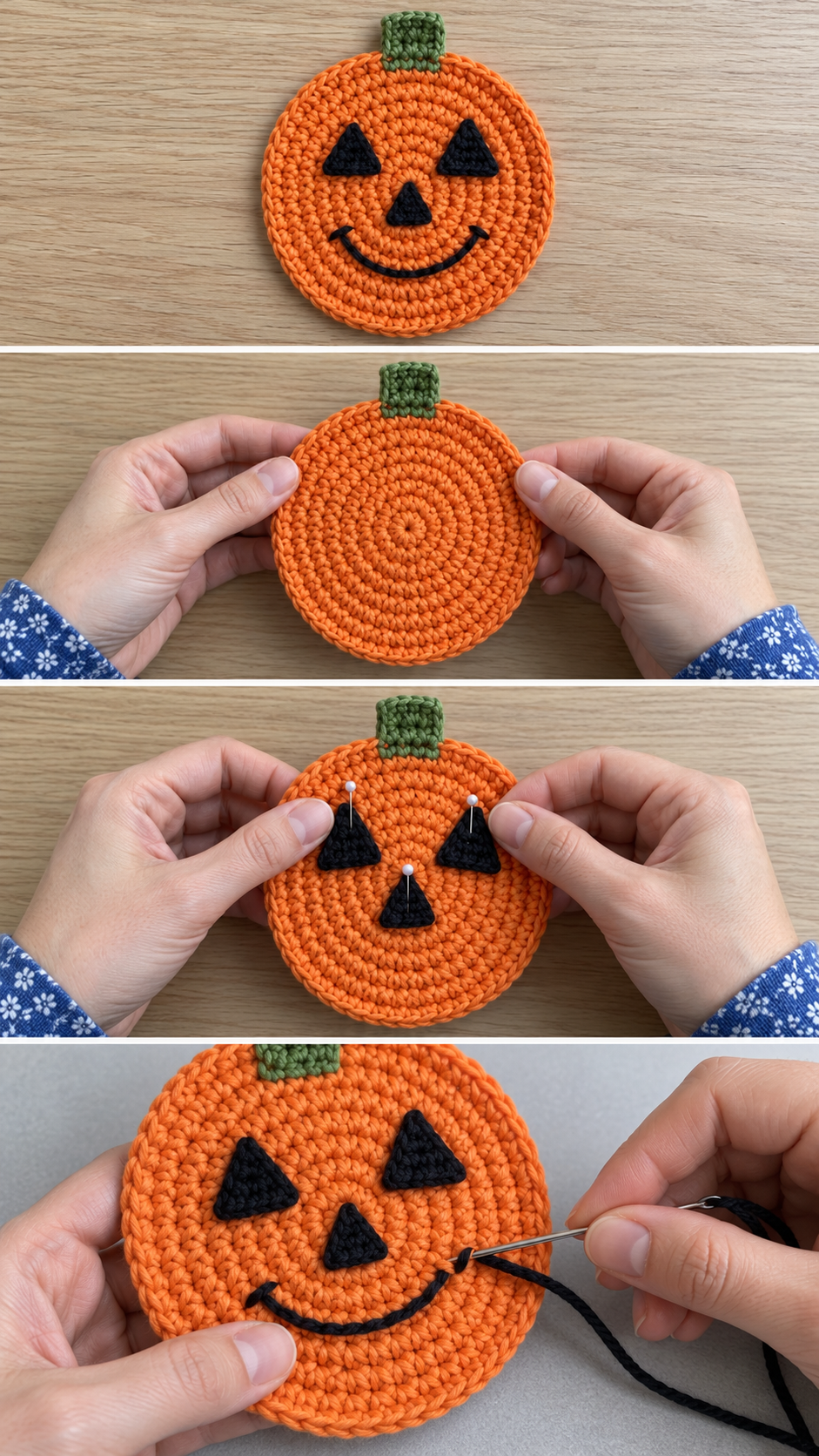
Pin the eyes about a third of the way down from the stem, with the points facing up for a happy face or inward for a spooky one. Pin the nose in the centre. Look at it from a distance before sewing — tiny changes in angle change the whole expression. Sew each triangle flat around its edges.
For the mouth, use black yarn and backstitch a wide curve below the nose. Add two or three short vertical stitches across it for teeth.
Face ideas
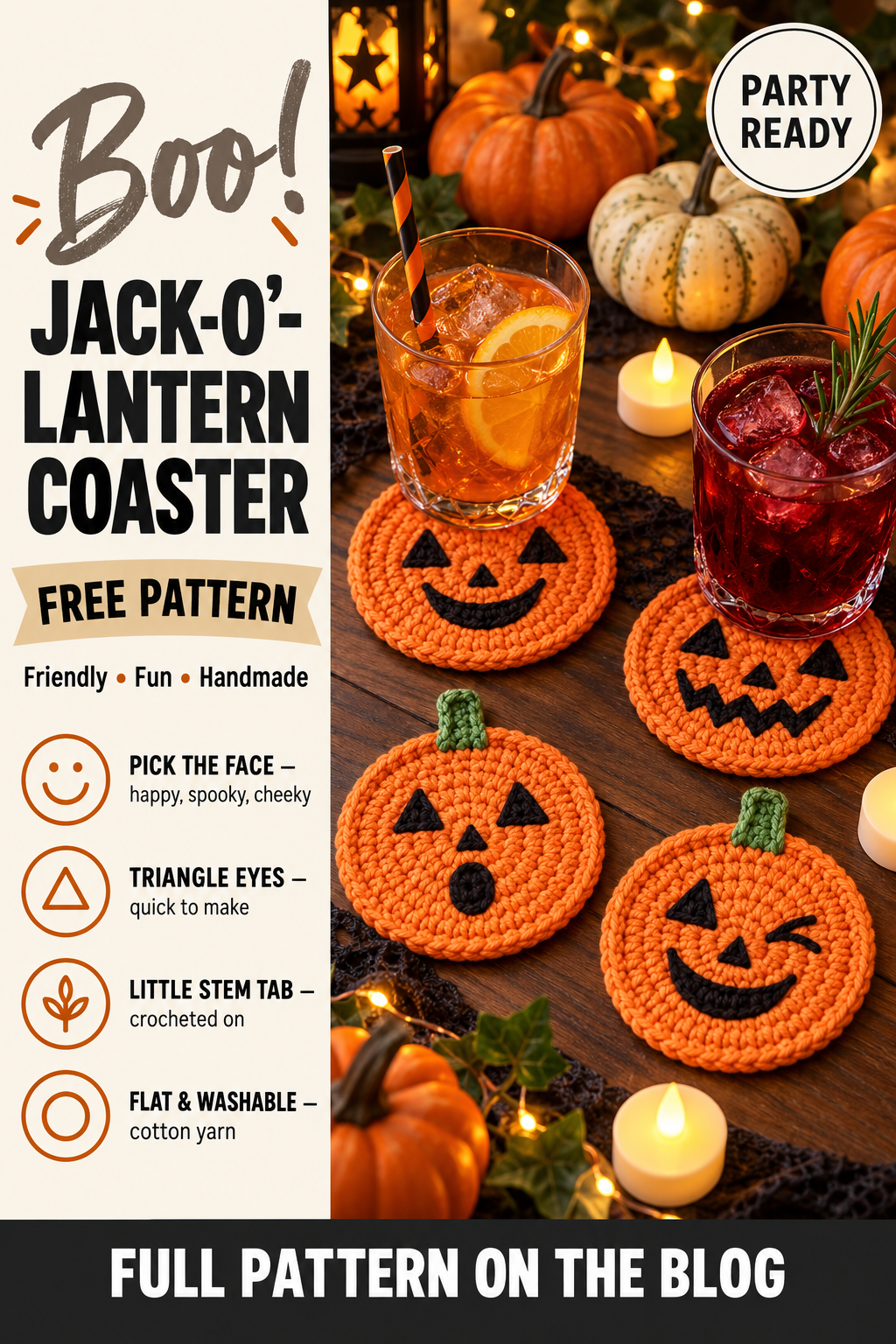
- Happy: eyes pointing up, a wide smile with one tooth.
- Spooky: eyes slanting inward, a jagged zigzag mouth.
- Surprised: round eyes (6 sc into a magic ring) and a small round “o” mouth.
- Cheeky: one eye winking as a short curved line, a lopsided grin.
- Sleepy: two curved lines for closed eyes and a tiny smile.
A set of four with four different faces is far more fun than four identical ones.
Colour ideas
Traditional orange is classic, but white “ghost” pumpkins with black faces look striking, and a soft peach or mustard looks gentle and modern. Green or purple pumpkins with black faces are great fun for a children’s party.
Finishing and care
Weave in all ends on the back. Machine wash cool in a laundry bag and dry flat; steam the edge flat if needed.
Frequently asked
Can I crochet the face directly instead of sewing it?
Yes, with surface slip stitch: hold the yarn behind the coaster and slip stitch through the fabric along the shape of the mouth. It sits flatter than appliqué.
Why is my circle wavy?
There is an extra increase. Count each round: 12, 24, 36, 48.
Can I use it as a decoration?
Add a loop of chain at the top of the stem and hang it on a door or a branch.
Why cotton is the right yarn for coasters
Coasters have two jobs: protecting a table from heat and soaking up the drips from a cold glass. Cotton does both better than any other fibre. It absorbs moisture instead of letting it run off, and it tolerates the heat of a hot mug without softening, melting or going shiny the way some acrylics can. It also washes well again and again, which matters for something that sits under coffee every day.
Look for plain worsted-weight kitchen cotton or a recycled cotton. Mercerised cotton has a lovely sheen and crisp stitches but absorbs a little less; it is perfect for decorative coasters and party tables.
Blocking coasters flat
Even a well-made coaster can curl slightly at the edge. Blocking fixes it in minutes. Wet the coaster, press out the water in a towel, lay it flat, pat it into shape and leave it to dry. For a quicker result, lay a damp cloth over it and press with a warm iron, lifting rather than sliding. Cotton responds very well to steam, and once blocked the coaster stays flat through many washes.
A jack-o’-lantern party set
Make one coaster for each guest with a different face, and let everyone choose their favourite at the start of the party. For a children’s party, hand out the coasters as favours at the end. It is a small touch that makes a Halloween table feel planned and personal.
Common mistakes
The face looks lopsided: the eyes are at slightly different heights. Pin both eyes and check from a distance before sewing. The triangles curl: steam them flat before sewing them on. The stem tab flops: work it a little tighter, or add one more row of sc to make it stiffer.
How long it takes
The orange circle takes about twenty minutes, the three triangles another ten, and sewing the face and embroidering the mouth about fifteen. A full set of four, each with a different expression, is an easy evening project.
Using leftover yarn
Jack-o’-lantern coasters are a great way to use up scraps. The faces need only a few yards of black, and the stems a yard or two of green. If you have small amounts of several oranges, use a different shade for each coaster in a set — it looks like a real pumpkin patch, where no two pumpkins are quite the same colour.
Storing them between seasons
Wash the coasters at the end of Halloween, dry them flat, and store them in a small box or a cloth bag with the rest of your seasonal decorations. Keep them flat so the stem tabs and faces stay neat. A cotton coaster cared for like this comes out looking new every October for years.
Before you start
Decide on the face you want and sketch it on paper. It is the part people notice first. More Halloween makes are in Halloween.